
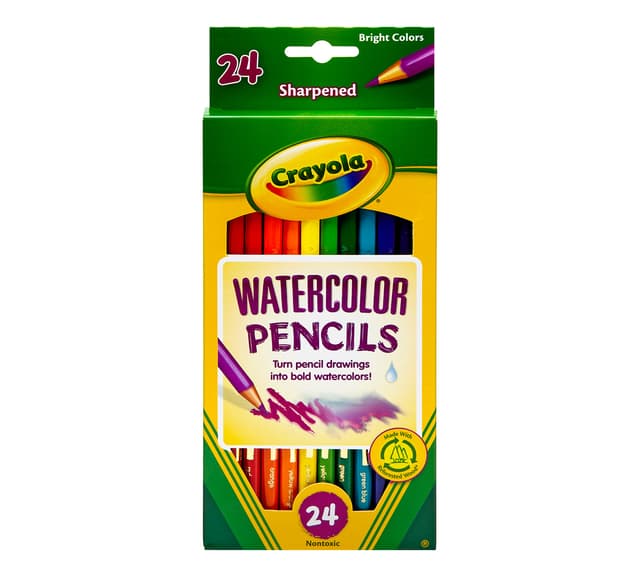
Let's be honest about what these are
Crayola is not trying to compete with Faber-Castell. The company makes art supplies for accessibility, not for professional studios, and the Crayola watercolor colored pencils are exactly what they say on the box. Hobby grade. Beginner grade. Made so that a kid or a curious adult can pick them up at a craft store for under ten dollars and have a genuinely good time.
The pigment is not lightfast. The leads are not as richly loaded as a Derwent or a Staedtler Karat Aquarell. The core feels slightly different in your hand compared to professional watercolor pencils. None of that is a scandal. It's the expected trade-off at this price point. The problem would be buying these thinking they perform like artist-grade tools. They don't. But used for what they're designed for, they work exactly as intended.
How they actually perform
Dry, the color payoff is decent. Nothing exceptional, but the marks are clean and the 50 colors cover the spectrum without obvious gaps. When you add water, the pigment dissolves more smoothly than I expected. Basic washes, wet-on-dry layering, blending adjacent colors while still wet. All of that works. The transitions are soft rather than dramatic, but for the price that's reasonable.
Where they fall behind artist-grade pencils is in how many times you can layer. The pigment deposits run out faster. On a professional set you might get six or seven wet layers before the surface becomes unworkable. With Crayola I'd say three or four before the result starts to look muddy. For simple work that's fine. For anyone trying to build up deep, complex color in multiple passes, it becomes limiting.
The cores are reasonably strong. I didn't break any during normal use, though I did snap one pencil when I dropped it on a hard floor, which is pretty standard for any pencil at this grade.
Where they work well
I used them for a full week of watercolor journal pages and honestly enjoyed it. There's something freeing about working with supplies you're not worried about using up. No second-guessing which color to reach for. No rationing a $3 pencil.
They travel well because you don't stress about losing them. They survive kids' art classes where sets go missing or get sat on. If you're not sure whether you prefer hot press or cold press, running experiments on Crayola pencils is smarter than burning through a set that costs twenty times more. I've used them for paper testing specifically and they're genuinely useful for that.
Where they fall short
Lightfastness is not rated, and that's a real limitation if you care about your artwork's longevity. Any piece you make with these pencils and display in light will fade over time. For a kid's drawing that lives on the fridge for a month, this doesn't matter. For anything you want to keep or sell, it does. Buy artist-grade pencils if permanence is a concern.
The color saturation is also noticeably lower than even mid-range alternatives. Side by side with Prismacolor watercolor pencils, the Crayola colors look duller, particularly in the reds and deep blues. The leads have a slightly chalky texture that some people find pleasant and others find frustrating. I'd describe it as acceptable rather than good.
Are they good for kids?
Yes, without qualification. They're non-toxic, they meet ASTM D4236 safety standards, and they're durable enough for normal kid handling. The colors are cheerful and bright in a way that genuinely engages children, which matters when you're trying to get them interested in making art. At this price, you're not stressed when pencils go missing or get snapped. A full 50-color set costs about as much as a single professional watercolor pencil in some lines.
One thing parents ask: do they stain? Less than you'd think. The water-soluble pigment wipes off skin and most surfaces without much effort, especially if you catch it while it's still wet.
Crayola vs Prismacolor for beginners
Both are aimed at the non-professional market, but they sit at different points on the quality spectrum. Crayola is the cheaper entry point and the right choice if you're not sure watercolor pencils are for you, or if you're buying for a child. Prismacolor is a step up: better pigment, richer color, leads that blend more smoothly.
If you're an adult who has decided watercolor pencils are your medium and you want to actually improve, I'd recommend spending slightly more and starting with Prismacolor. The technique skills you build on a better set transfer directly and you won't need to unlearn habits that only work on budget pencils. But if you're on the fence and want to spend as little as possible to find out, Crayola does the job.
Best for
- ✓ Young artists and beginners
- ✓ School and classroom projects
- ✓ Trying watercolor pencils cheaply
- ✓ Gift sets for kids or students
Not ideal for
- ✗ Anyone past the beginner stage
- ✗ Artists who need lightfast colors
- ✗ Professional or display-quality work
- ✗ Anyone serious about the medium
Crayola vs Staedtler Karat Aquarelle
Both are entry-level options. Here is what the test results show:
| Criteria | Crayola | Staedtler Karat |
|---|---|---|
| Pigment Quality | 6.0 / 10 | 7.8 / 10 |
| Lightfastness | 5.5 / 10 | 7.5 / 10 |
| Water Solubility | 7.8 / 10 | 8.0 / 10 |
| Value for Money | 9.2 / 10 | 8.8 / 10 |
| Build Quality | 7.0 / 10 | 8.2 / 10 |
| Best for | Kids, classroom use | Beginners, adult hobbyists |
| Set sizes | 12–36 colors | 12–48 colors |
Crayola wins on price. Staedtler wins on everything else — pigment, lightfastness, and build. If you are an adult learning the medium, start with Staedtler.