Faber-Castell Albrecht Dürer Watercolor Pencils: My Honest Review
Quick Summary
- Best for: Serious hobbyists and professional artists
- Set sizes: 12, 24, 36, 60, 72, 120 colors
- Price range: $$$
- Bottom line: The most reliable artist-grade watercolor pencil I have tested.
Criteria Scores
First impressions
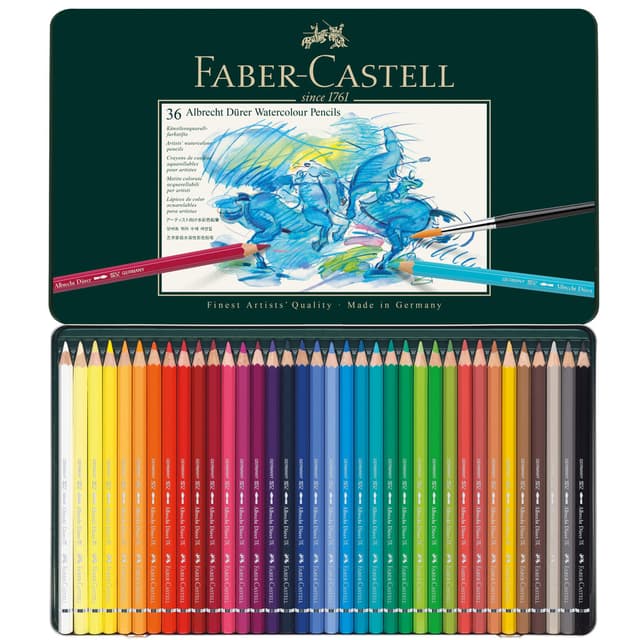
The 72-color tin arrived in better shape than I expected — Faber-Castell packs these well, and none of the pencils had shifted. Opening the lid, the colors are arranged by hue family, which sounds like a small thing but saves real time when you are working. No hunting through a jumbled row trying to tell one blue-green from another.
The pencils themselves feel solid. The barrels are hexagonal, which I prefer — they do not roll off the table, and the grip is more comfortable during long sessions than round barrels. The cedar casing sharpens cleanly, and I did not get a single breakage in the first round of sharpening, which is not always the case with watercolor pencils. The core diameter is 3.8mm, which puts them on the softer end of artist-grade pencils.
My overall impression in the first hour of use was that these feel like tools made for people who are actually going to use them. The tin lid fits properly, the color labeling is clear, and the pencils themselves have the slight waxy resistance in the hand that tells you the lead is dense. None of the cheap, chalky feel you sometimes get even with mid-range sets.
Pigment quality and color range
Dry, the Albrecht Dürer pencils lay down rich, saturated color. The darker values in particular are impressive — the indigos, deep greens, and alizarin crimson look almost overworked in the best possible way, like there is more pigment in there than the pencil knows what to do with.
The earth tones are exceptional. Burnt sienna, raw umber, the various ochres — they are warm and complex in a way that cheap watercolor pencils almost never manage. Botanical illustrators specifically tend to live in this part of the palette, and the Albrecht Dürer earths hold up under close inspection in a way that matters for that kind of detail work.
The lighter colors — Naples yellow, the pale lavenders, the lighter pinks — are less impressive. They look slightly washed out dry and do not deepen as dramatically as I would like when water hits them. This is a pretty common limitation across the category; lighter pigments are just harder to load densely. It is worth knowing going in rather than being surprised.
I have used Caran d'AcheSupracolor alongside these, and the honest comparison is this: Caran d'Ache has slightly more pigment density in the midrange colors and an edge in wash evenness. The Albrecht Dürer earth tones are better. For most artists, either set is excellent; the gap between them is smaller than the price difference between brands suggests.
How they perform with water
This is where the Albrecht Dürer earns its reputation. These pencils dissolve fully with a modest amount of water — you do not need to scrub with the brush to get a smooth wash. A medium-wet brush over a moderately heavy application gives you clean, even color that flows the way watercolor paint does, not the gummy or streaky result you get from lesser pencils.
I tested the dissolve rate systematically, using the same brush load and pressure across twelve colors including both saturated and light values. The darker colors dissolved more completely, as expected, but even the lighter pigments released cleanly without visible grain. The washes stayed workable slightly longer than I expected, which matters for blending before the paper dries.
Layering behavior is strong. You can apply color dry, activate it, let it dry fully, and then add another layer without disturbing the layer below — which is important for building depth in botanical work or portrait illustration. Colors lift slightly when wet but do not muddy each other badly when layered thoughtfully. The greens and blues in particular layer cleanly.
One practical note: on rough paper, apply the pencil dry more lightly than you think you need to. Heavy applications on rough texture can leave pigment deposits in the grain that resist water and look uneven. A lighter first pass with two coats gives better results than a single heavy application.
Lightfastness
Faber-Castell rates most Albrecht Dürer colors at lightfastness III or IV on their internal scale, which corresponds to ASTM I and II — excellent and very good, respectively. In practice, the majority of the 72-color set falls in territory that is safe for artwork intended to sell or display long-term.
A handful of colors, mostly in the violet and fluorescent ranges, carry a II rating (good, but not excellent). If you work in those hues frequently and produce work for sale, it is worth checking the lightfastness chart that comes with the tin.
Lightfastness matters most if your finished pieces will be displayed under regular light — especially natural light. Work sold at galleries, botanical prints, or anything framed and hung in a sunny room will show fading over years with poor lightfastness colors. For sketchbook work or pieces kept in a portfolio, it is much less of a concern. The Albrecht Dürer range gives you more safe choices than almost any other artist-grade pencil set at this price.
Set size guide
The Albrecht Dürer line comes in 12, 24, 36, 60, 72, and 120 colors. Here is my honest read on each:
- 12-color set: Fine as a sample, genuinely limited as a working set. You will spend more time mixing to fill gaps than actually drawing.
- 24-color set: A solid step up but still tight. Missing too many useful midrange colors.
- 36-color set: The sweet spot for most people. Full spectrum coverage, manageable cost, and enough variety to work without constantly feeling hemmed in. Start here.
- 72-color set: The right choice if you are serious about the medium. The additional colors are not redundant — they cover subtle variations that matter for complex subjects.
- 120-color set: Specialist territory. Unless you have a specific reason — a subject that requires very precise color matching across dozens of hues — this is more pencils than most artists will ever realistically use.
If I had to give one recommendation: buy the 36, use it for six months, then upgrade to 72 if you find yourself frustrated by the gaps. Most people do.
Faber-Castell vs Caran d'Ache Museum Aquarelle
Both sit at the top of the professional category. The honest comparison:
| Criteria | Faber-Castell Albrecht Dürer | Caran d'Ache Museum Aquarelle |
|---|---|---|
| Pigment Quality | 9.2 / 10 | 9.8 / 10 |
| Lightfastness | 9.0 / 10 | 9.5 / 10 |
| Water Solubility | 8.8 / 10 | 9.2 / 10 |
| Value for Money | 7.5 / 10 | 6.8 / 10 |
| Build Quality | 8.8 / 10 | 9.5 / 10 |
| Best for | Earth tones, botanical work | Max pigment density, fine art |
| Set sizes | 12–120 colors | 18–120 colors |
Pick Faber-Castell if value-per-color matters. Pick Caran d'Ache if you want the absolute ceiling of the category and price is secondary.
Pros and cons
- Exceptional pigment quality, especially in the dark and earth tone ranges
- 120 colors at the top end — wide enough that most artists never run into gaps
- Excellent lightfastness across most of the palette
- Breaks rarely — the leads are well-bonded and survive sharpening reliably
- Consistent pigment load across the full color range, not just the flagship colors
- Expensive — the 72-color tin is a significant investment
- The tin feels slightly flimsy given the price; the lid hinge in particular is not confidence-inspiring
- Lighter colors are noticeably less impressive than darker ones
Who should buy Albrecht Dürer pencils?
If you have been working with Staedtler Karat or Derwent Academy pencils and feel like the pigment is holding you back, Albrecht Dürer will feel like a genuine step up. The difference is most obvious in wash quality and color depth — things you cannot compensate for with technique alone.
Botanical illustrators in particular: the earth tone range is outstanding, the lightfastness is reliable, and the layering behavior is precise enough for detailed work. I see these in serious illustrators' kits more than any other brand, and there is a reason for that.
For beginners, honestly, probably overkill. If you are still learning how water behaves with watercolor pencils, the difference between Albrecht Dürer and a decent mid-range set will not be your limiting factor. Start with a 36-color Staedtler Karator a Derwent 24 set. Come back to Faber-Castell when your technique has caught up to the tool.
Best for
- ✓ Serious hobbyists stepping up
- ✓ Botanical & scientific illustrators
- ✓ Artists selling or displaying work
- ✓ Anyone buying once and keeping
Not ideal for
- ✗ Complete beginners
- ✗ Casual sketchbook artists
- ✗ Kids or classroom use
- ✗ Budget-first buyers
Keep reading
Frequently asked questions
Are Faber-Castell Albrecht Dürer watercolor pencils worth the price?
Yes, if you are past the beginner stage. The pigment load is consistent across the entire range, the lightfastness ratings are among the best in the category, and the leads hold up well under pressure. A 36-color set will last years with normal use. For casual hobbyists, the price is harder to justify — but for anyone doing serious work, these pay for themselves in results.
What is the difference between Albrecht Dürer and Goldfaber Aqua?
Albrecht Dürer is the professional line — higher pigment concentration, better lightfastness ratings across the board, and a slightly softer lead that dissolves more completely with water. Goldfaber Aqua is the student line, with lower pigment load and more variable lightfastness. Both perform well for their price point, but they are genuinely different products, not just different names for the same pencil.
Which set size should I start with?
The 36-color set is the right starting point for most people moving into artist-grade pencils. It covers the full spectrum without overlap, costs significantly less than the 72, and gives you enough range to understand what you are working with. Move to 72 when you find yourself consistently reaching for colors you do not have. The 120 is only worth the investment if you have very specific color needs — botanical illustration with complex greens, for instance.
Do Faber-Castell watercolor pencils work on regular paper?
They will work on regular paper, but you will not get good results. Ordinary copy paper or thin sketchbook paper buckles badly when wet and tears easily. For these pencils, use at least 90lb (185gsm) cold-press watercolor paper. If you are spending money on artist-grade pencils, pair them with decent paper — it makes more difference than most people expect.
Related reviews

Written & tested by
Maya CollinsWatercolor artist with 12 years of experience. Every set reviewed on this site is tested by hand — no spec sheets, no guesswork.