Derwent Watercolour Pencils: My Honest Review
Quick Summary
- Best for: Artists and illustrators who prefer a slightly harder lead
- Set sizes: 12, 24, 36, 72
- Price range: $$$
- Bottom line: A well-crafted British pencil with an outstanding blue and green range. Slightly harder feel than Faber-Castell, which is either a feature or a limitation depending on your style.
Criteria Scores
First impressions
Derwent has been making pencils in Keswick, England since 1832. That history comes through when you hold one of these — there is something intentional about the weight and finish that cheaper competitors cannot quite replicate, even when the price is similar. The barrels are round, which is a minor preference issue for me (I find hexagonal more comfortable for long sessions), but the cedar is good quality and sharpens without splintering.
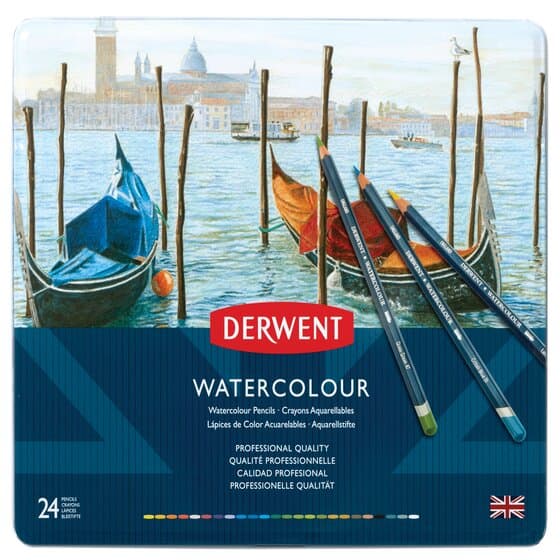
The 72-color tin is laid out sensibly by hue family. The colors look slightly cooler and more muted than Faber-Castell in the tin, less immediately flashy, but that undersells them. The blue and green sections in particular caught my attention before I even made a mark. There is a depth in those pigments, especially the Prussian blue and viridian, that signals something worthwhile.
The lead diameter is 3.4mm, compared to Faber-Castell's 3.8mm. That 0.4mm difference is noticeable in use. The Derwent lead feels slightly harder and more controlled under the hand. It produces a finer dry line, which is a genuine advantage for detailed or illustrative work. It also means the pencils feel less immediately smooth than the Faber-Castell, which takes a short adjustment period.
Pigment quality and color range
The blue and green range in this set is outstanding. I do not say that lightly. The Prussian blues, ceruleans, and viridians lay down color with real depth, and when wetted they produce washes that hold their chromatic character rather than going grey or muddy. For anyone who works with a lot of ocean, foliage, or sky — these are genuinely excellent.
The earth tones are a different story. Compared to Faber-Castell Albrecht Dürer, the burnt sienna and raw umber feel slightly flatter and less warm. They are not bad, but the gap is noticeable in a direct comparison. If botanical illustration or warm landscape work is your primary focus, this matters.
The overall pigment load is slightly lower than Faber-Castell in side-by-side swatch tests. The difference shows up most clearly in the darker saturated colors — deep purples, rich reds — where the Derwent version lays down a bit less intensity per stroke. For most uses this is not a practical issue, but if you are comparing the two sets directly, you will see it.
The color range across the 72-set covers the full spectrum well, with genuinely useful variation rather than near-duplicates filling out the count. The violet range is thoughtfully chosen and includes some useful intermediate tones that are not common in competitor sets.
How they perform with water
Derwent Watercolour pencils require slightly more water than Albrecht Dürer to fully dissolve. A moderately wet brush will get you a workable wash, but to get the pigment moving freely you need a bit more moisture than you might expect. On cold-press paper this resolves easily; on smoother hot-press the pencil texture resists the brush more.
The payoff is that the resulting washes are genuinely beautiful. Where Faber-Castell leans toward richness and density, Derwent washes have a luminous, slightly translucent quality that photographs particularly well. The blues and greens in wash are some of the best I have seen from any watercolor pencil — they stay clean and avoid the muddiness that kills this kind of color in lesser products.
Layering is reliable. The pencil takes well to being wetted, dried, and re-drawn over, and the slightly harder lead means you have precise control over where each subsequent layer lands. This is the characteristic that illustrators particularly appreciate — you can build up fine detail in dry layers between wash passes without losing the crispness of your lines.
One issue worth flagging: on rough-textured paper, the 3.4mm lead can feel scratchy. Not to the point of tearing paper, but with a slightly abrasive quality that is absent on smoother surfaces. If you work primarily on rough-grain paper, factor that into your decision. Cold-press is fine; hot-press is ideal.
Lightfastness
Most Derwent Watercolour colors rate III or IV on Derwent's lightfastness scale, which aligns with ASTM I and II — the good to excellent range. For the majority of the palette, these pencils are safe for artwork that will be displayed or sold.
The violet range is a weak spot. Several violet and red-violet colors carry lower lightfastness ratings than the rest of the set. If you work heavily in that range and produce work for sale or display, check the individual ratings before relying on those specific colors for finished pieces. Swapping to more lightfast alternatives for violets — such as dioxazine purple mixed from more stable pigments — is worth considering.
For sketchbook work, studies, or pieces kept away from direct light, lightfastness is much less of a practical concern. The ratings matter most for gallery-quality finished work and anything framed in bright conditions.
Set size guide
Derwent Watercolour comes in 12, 24, 36, and 72 colors. Unlike Faber-Castell, there is no 120-color option — which is honestly sensible for most artists.
- 12-color set: Too limited to work properly with. Useful as a test set, not as a working kit.
- 24-color set: Workable but still missing useful midtones. A few too many gaps for sustained use.
- 36-color set: The best value entry point into Derwent. Full enough to work with seriously, priced accessibly. This is where most artists should start.
- 72-color set: For artists who have already worked with a 36 and found the palette limiting. The added colors are genuinely useful additions, not just near-duplicates.
My recommendation: start with the 36-set tin. It gives you enough range to understand what Derwent does well, and it is significantly more affordable than jumping straight to 72. The tin packaging is also the best value format for keeping the pencils organized and protected.
Derwent vs Staedtler Karat Aquarelle
Both are honest mid-range sets. Here is how they separate:
| Criteria | Derwent Watercolour | Staedtler Karat Aquarelle |
|---|---|---|
| Pigment Quality | 8.3 / 10 | 7.8 / 10 |
| Lightfastness | 8.0 / 10 | 7.5 / 10 |
| Water Solubility | 8.8 / 10 | 8.0 / 10 |
| Value for Money | 8.5 / 10 | 8.8 / 10 |
| Build Quality | 8.2 / 10 | 8.2 / 10 |
| Best for | Fine line, detailed work | Beginners, everyday use |
| Set sizes | 12–72 colors | 12–48 colors |
Pick Derwent for better pigment and lightfastness. Pick Staedtler if budget is the primary concern.
Pros and cons
- Outstanding blue and green pigment range — best in class for those hues
- Slightly harder lead produces excellent fine line work and precise detail
- Beautiful, luminous wash quality in the mid and cool tones
- British manufacturing and long heritage; consistent quality across batches
- Sensible color range with no obvious filler or near-duplicates
- Slightly less pigmented than Faber-Castell in direct comparison, especially in dark and warm tones
- Earth tones are somewhat flat compared to Albrecht Dürer
- Thinner lead can feel scratchy on rough paper
- Requires slightly more water to fully dissolve than some competing sets
- Several violet colors have lower lightfastness ratings
Who should buy Derwent Watercolour pencils?
The 3.4mm lead is the main argument for choosing Derwent over Faber-Castell. If your process involves laying down precise dry lines and then selectively activating them with water, the harder lead rewards that approach more than the softer-leaded alternatives. Urban sketchers and technical illustrators tend to find these satisfying for exactly this reason.
If blues and greens are central to your palette — seascapes, foliage-heavy botanical subjects, atmospheric skies — the Derwent range in those hues is worth the price on its own. The cool spectrum is better than Faber-Castell in a direct comparison, and that matters if that part of the palette is where you spend most of your time.
If you are upgrading from a student set, the 36-color Derwent is a reasonable first step. The quality improvement over entry-level pencils is obvious right away. Just know that Derwent needs a slightly wetter brush than you might be used to — it takes a session or two to adjust if you have been working with softer leads.
Best for
- ✓ Beginners ready for artist-grade
- ✓ Fine line and detailed work
- ✓ Artists who want a wide color range
- ✓ UK-made quality at mid-range price
Not ideal for
- ✗ Maximum pigment density needs
- ✗ Professional archival work
- ✗ Wet-heavy wash painting
- ✗ Artists prioritizing lightfastness above all
Keep reading
Frequently asked questions
How do Derwent watercolour pencils compare to Faber-Castell?
Side by side, Faber-Castell Albrecht Dürer has a slight edge in pigment density and earth tone quality. Derwent leads are 3.4mm versus 3.8mm, which makes them slightly harder and better suited to fine line work and detailed drawing. Derwent blues and greens are genuinely outstanding and give Faber-Castell real competition in that range. For general use, Faber-Castell is the stronger all-rounder; for precise detail work and line drawing, Derwent is the better choice.
Are Derwent Watercolour and Derwent Inktense the same?
No, they are quite different products. Derwent Watercolour pencils behave like traditional watercolor when wet — the color softens, lifts, and blends like paint. Derwent Inktense pencils use an ink-based formulation that becomes permanent once dry, producing much more saturated, intense color that cannot be re-wetted or lifted after drying. Inktense is better for bold, high-contrast work; Watercolour is better for subtle washes, layering, and traditional techniques.
Which Derwent set size is best for beginners?
The 36-set tin is the best entry point for someone new to artist-grade pencils. It gives you a complete working palette without the cost of the 72, and the tin keeps them organized. The 12 and 24 sets are too limited to get a real feel for what these pencils can do — you end up compensating for missing colors rather than learning the medium. If budget is a concern, the 24-set is workable, but go straight to 36 if you can.
Do Derwent pencils work on canvas?
Derwent Watercolour pencils are designed for paper, specifically cold-press watercolor paper. On canvas, the texture is too coarse for the 3.4mm lead to lay down color smoothly, and the surface does not absorb water in a way that lets the pigment dissolve properly. For canvas work, Derwent Inktense blocks or conventional watercolor paint will serve you better.
Related reviews

Written & tested by
Maya CollinsWatercolor artist with 12 years of experience. Every set reviewed on this site is tested by hand — no spec sheets, no guesswork.