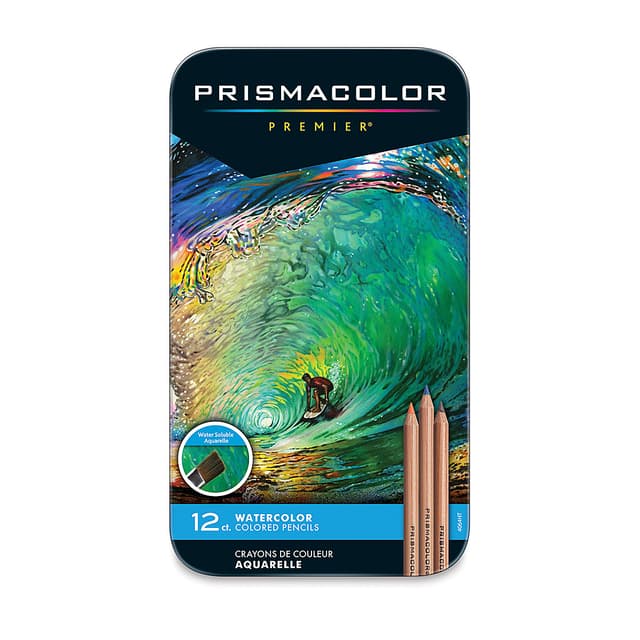
Prismacolor Watercolor Colored Pencils: My Honest Review
Affiliate disclosure: We earn a small commission on purchases made through links on this page, at no extra cost to you.
Quick Summary
- Best for
- Mid-range buyers, American artists, colored pencil artists transitioning to watercolor
- Set sizes
- 24, 36
- Price range
- $$ (mid-range)
- Rating
- 4.4/5
Bottom line:Great mid-range pick with thick, buttery leads and rich pigment. Just make sure you're using heavy watercolor paper — these pencils push a lot of moisture into the page.
Criteria Scores
What makes Prismacolor different
Prismacolor is an American brand, and it built its reputation on the Premier colored pencil line — soft, wax-based pencils that became a favorite among illustrators and portrait artists. The watercolor line is an extension of that identity rather than a completely separate product. That heritage shows in the leads: they are thick (4mm) and noticeably softer than what you get from European competitors like Faber-Castellor Caran d'Ache.
That softness is genuinely pleasurable to draw with. There's very little resistance on the paper, colors layer easily, and you can build up rich pigment deposit without pressing hard. The flip side is that soft leads are more fragile — these break more often than firmer-leaded pencils if you drop them or sharpen aggressively. I'd recommend sharpening slowly and keeping them horizontal when not in use.
For someone coming from Prismacolor colored pencils specifically, picking up the watercolor version feels immediately familiar. The weight, the draw feel, even the color names carry over. That ease of transition is one of the best arguments for choosing these over a European brand.
Pigment quality
The colors are rich. I tested the 36-set side by side with Faber-Castell Albrecht Dürer and Derwent Watercolour, and Prismacolor held its own in saturation across most of the palette. The reds are deep and warm. The blues — particularly the darker navy and ultramarine shades — come through with real intensity once activated.
Earth tones are decent but not as complex as you get from a professional-grade set. The siennas and ochres look a bit flat by comparison. That's a minor complaint given the price point, but worth knowing if earth tones are central to how you work.
One thing to be aware of: these lay down a lot of pigment fast. On lighter paper, that can mean color bleeding through to the other side. Use 140lb (300gsm) minimum. I learned this the hard way on a sketchbook page that ended up double-sided whether I wanted it to or not.
Water behavior
Prismacolor watercolor pencils dissolve quickly. Faster than Faber-Castell in my testing. A small amount of water goes a long way, which makes washes smooth and easy to control once you get a feel for the ratio. For beginners especially, that quick dissolution is a real advantage — you don't have to scrub at the paper to blend.
Before wetting, the marks can feel slightly waxy on the surface. That's a side effect of the soft binder formula. It doesn't affect how the color activates, but if you're working in layers and need to let marks dry between sessions, handle the paper carefully — the unwetted pigment can smear if you rest your hand on it.
Once wet and dried, the washes are clean and smooth. No graininess, no uneven edges. Multiple wet passes do blend colors together, though blending colors from opposite sides of the wheel can get muddy if you over-work the wash. That's a watercolor problem in general, not specific to Prismacolor.
Lightfastness
This is the honest limitation of the Prismacolor line. Lightfastness — how well a color resists fading when exposed to light over time — is not rated as consistently as you get with Faber-Castell or Caran d'Ache. Prismacolor does not publish detailed lightfastness data for every color in the watercolor line the way professional European brands do.
Reds and purples are the most vulnerable. I've seen reviews from artists who framed work made with these pencils and noticed fading within a year of display near a window. For practice work, studies, and hobbyist projects that live in sketchbooks or portfolios, that doesn't matter. But if you're making finished pieces for sale or long-term display, lightfastness becomes a real factor — and Faber-Castell or Caran d'Ache are the better choice for that use case.
Prismacolor vs Faber-Castell Albrecht Dürer
I did a direct comparison across several categories: pigment feel, water behavior, lightfastness, and value. Here's where each one comes out ahead.
Faber-Castell wins on lightfastness — it's not close. The Albrecht Dürer line publishes ratings for every single color and most are rated I or II (excellent to very good). Faber-Castell also has a slightly firmer lead that's better for fine detail work and less prone to breaking. If you want precise, archival-quality results, Faber-Castell is the pick.
Prismacolor wins on feel and price. The softer lead is genuinely more satisfying for artists who like a buttery, expressive drawing experience. The colors are slightly warmer in tone overall, which some painters prefer. And the price is lower by a meaningful margin — the 36-set Prismacolor costs noticeably less than a comparable Faber-Castell set.
My practical recommendation: if you already own Prismacolor Premier colored pencils and want to explore watercolor technique, buy the Prismacolor watercolor set. If you're starting fresh and lightfastness matters, spend the extra money on Faber-Castell.
Best for
- ✓ Hobbyists comfortable with color pencils
- ✓ Artists who already use Prismacolor colored pencils
- ✓ Mixed-media sketchbook work
- ✓ Anyone transitioning from dry to wet media
Not ideal for
- ✗ Professional or archival work
- ✗ Artists who care about lightfastness
- ✗ Fine botanical detail work
- ✗ Serious watercolor pencil collectors
Prismacolor vs Derwent Watercolour
Both sit in the mid-range. Here is how the test results compare:
| Criteria | Prismacolor | Derwent Watercolour |
|---|---|---|
| Pigment Quality | 7.5 / 10 | 8.3 / 10 |
| Lightfastness | 6.8 / 10 | 8.0 / 10 |
| Water Solubility | 8.2 / 10 | 8.8 / 10 |
| Value for Money | 8.0 / 10 | 8.5 / 10 |
| Build Quality | 6.5 / 10 | 8.2 / 10 |
| Best for | Color pencil crossover users | Fine line, detailed work |
| Set sizes | 24–72 colors | 12–72 colors |
Derwent leads on nearly every technical measure. Prismacolor makes sense if you already work in the Prismacolor ecosystem.
Pros and cons
What I liked:
- Thick 4mm leads that feel smooth and responsive
- Rich, saturated pigment — the reds and blues in particular
- Quick dissolution with minimal water needed
- Good transition option for existing Prismacolor users
- More affordable than European artist-grade alternatives
- Nice smooth washes with no visible grain
What I didn't like:
- No consistent lightfastness data published per color
- Reds and purples fade with prolonged light exposure
- Leads break more easily than firmer alternatives
- Earth tones lack complexity compared to professional-grade sets
- Pre-wet pigment smears if handled carelessly
- Requires thick paper — 140lb minimum
Who should buy these?
If you already work with Prismacolor Premier colored pencils, the watercolor line is the obvious next step. The transition is natural because the feel is so close — same soft lead, same warm color bias. You spend less time adjusting to a new tool and more time actually learning the watercolor techniques.
They also make sense for hobbyists who want noticeably better results than Crayola without committing to Faber-Castell prices. The pigment density and wash behavior are a genuine step up from budget sets, even if they don't hit archival standards.
Illustrators and designers working on editorial pieces, social media content, or portfolio sketches are a good fit too. When the work has a short display life, lightfastness simply isn't the deciding factor.
If you're a professional fine artist creating work for sale, or if you plan to frame and display your pieces long-term, look at Faber-Castell Albrecht Dürer instead.
Keep reading
Frequently asked questions
Are Prismacolor watercolor pencils artist grade?
They sit in a middle ground. Prismacolor markets them as premium, and the pigment quality is genuinely good — richer than student-grade sets from brands like Staedtler. But the lightfastness ratings are inconsistent compared to Faber-Castell Albrecht Dürer or Caran d'Ache Museum Aquarelle, which are the benchmarks for true artist-grade watercolor pencils. For practice, illustration work, and hobbyist projects, they're absolutely fine. For artwork you plan to sell or frame long-term, lightfastness matters more.
How do Prismacolor watercolor pencils compare to colored pencils?
The feel is similar because Prismacolor uses thick, soft leads in both lines — but the core formula is completely different. Watercolor pencils use a water-soluble binder instead of wax or oil, so you can activate the pigment with a wet brush. If you're already used to Prismacolor Premier colored pencils, the watercolor version will feel familiar to draw with. The main adjustment is getting used to how the pigment behaves once water is introduced.
What paper should I use with Prismacolor watercolor pencils?
Use 140lb (300gsm) cold-press watercolor paper as a minimum. The soft leads deposit a lot of pigment quickly, and lighter paper will buckle or even tear when you add water. Regular sketchbook paper or copy paper won't hold up. Hot-press watercolor paper works well if you want cleaner lines; cold-press gives you more texture and is better for looser washes.
Are Prismacolor watercolor pencils good for beginners?
Yes, with a caveat. They're easier to use than many artist-grade pencils because the soft lead forgives uneven pressure and dissolves quickly without needing a lot of water. That makes them approachable. The caveat: they're expensive enough that complete beginners might be better served by Crayola or Staedtler first. If you're already a colored pencil user and want to explore watercolor techniques, Prismacolor is a natural starting point.
Related reviews

Written & tested by
Maya CollinsWatercolor artist with 12 years of experience. I test every pencil set by hand before writing about it.